Bond traders were among the first to forecast the collapse of CoreWeave’s stock through last week, positioning themselves over a month ago when its stock price was twice as high as Friday’s close.
As early as October 13, traders were dumping the AI company’s bonds until yields soared to 15%, a spike above the moderate 9.6-9.8% yields at which the company initially sold those bonds.
Since October 13 when yields on CoreWeave’s corporate paper hit that 15%, CoreWeave’s stock price collapsed 48% through Friday’s close.
Indeed, prior to today’s Nvidia-driven rally, Friday’s close was pennies above its 52-week low and 70% below its high in May.
In April and June of this year, for context, CoreWeave sold 9.75% bonds maturing in October 2031 plus $1.25 billion of bonds yielding 9.625% maturing in 2032.
By October 14, bondholders had sold off CoreWeave’s 2032 bonds from 100 cents down to 75, and pushed five-year credit default swaps (CDS) to an alarming 1,130 basis points.
As traders sell bonds, prices fall, making yields-to-maturity (or simply, “yields”) rise. Bond traders sell and offer higher yields to others when they perceive the risk of default as more likely.
Bond traders and insiders sold before CoreWeave halved
Corporate insiders didn’t wait for equity holders to figure out CoreWeave’s problems during the first three weeks of November.
Aware of what was happening well in advance, company executives and board members unloaded roughly $740 million of shares between June’s Nasdaq 100 Index inclusion and mid-October, as Protos documented.
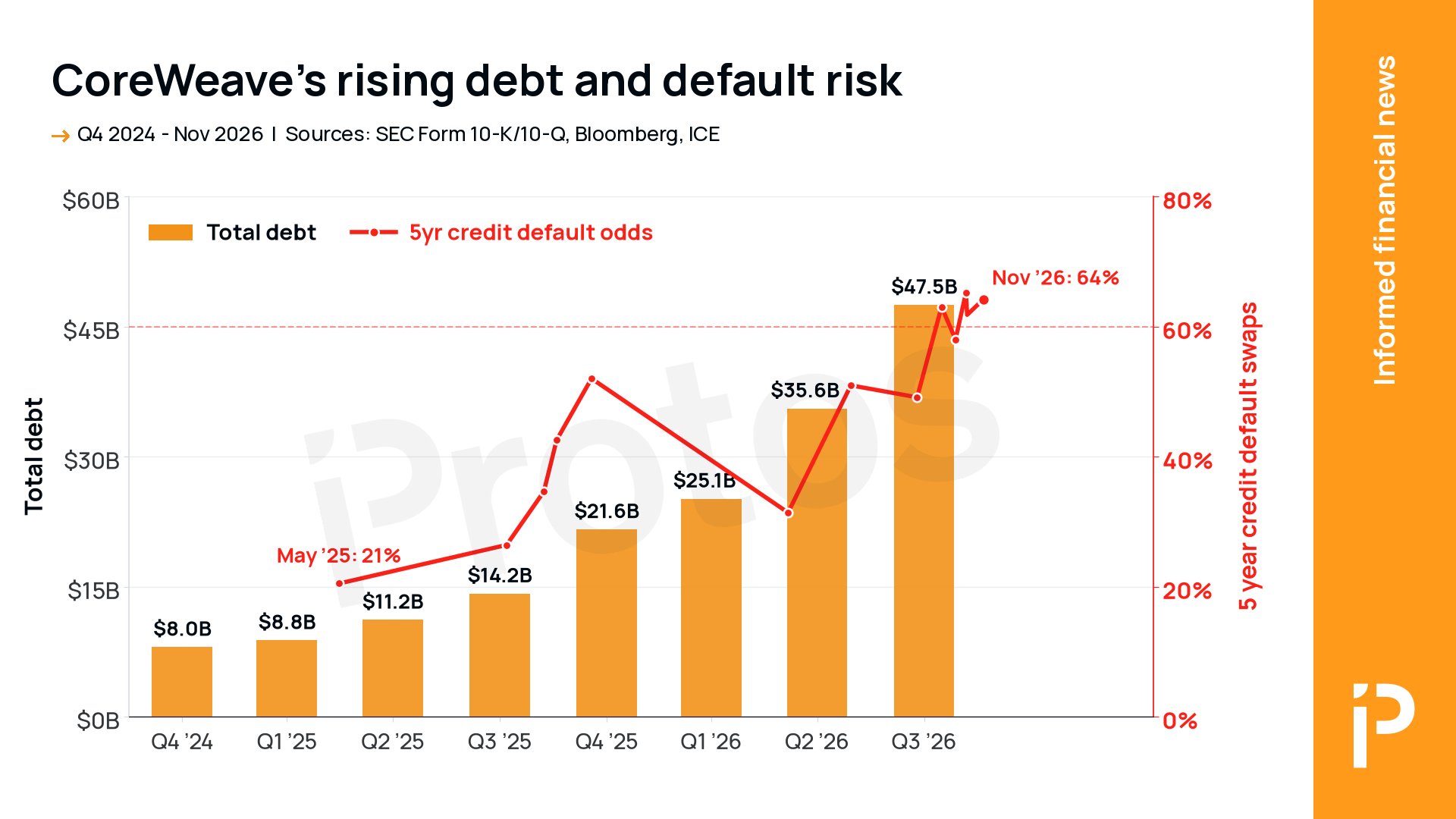
As of the end of the third quarter, CoreWeave’s debt schedule showed $41.6 billion in recourse debt, plus another $5.2 billion in non-recourse debt.
Net interest expense hit $846 million against $207 million in operating income, driving a $709 million quarterly loss.
Read more: Credit default swaps forecast AI bankruptcies
For the first nine months of 2026, CoreWeave’s capital spending of $23.6 billion dwarfed $5.6 billion in operating cash flow.
By September 30, $87.4 billion of the company’s total liabilities towered over stockholders’ equity of $4 billion.
As early as September 2025, short-seller Kerrisdale Capital warned that the former crypto miner “generates returns below its cost of capital.”
Finally, even initial skeptics have come to agree with that year-old analysis, with CoreWeave’s five-year default risk now priced near 60%.
On Polymarket yesterday, traders were slightly more optimistic, placing binary options bets on CoreWeave’s bankruptcy at 18% by next year, 23% by 2028, and 28% by 2029.
For context, prediction markets for other AI companies declaring bankruptcy by 2027 were far lower: 3% for Perplexity, 9% for OpenAI, and 9% for Anthropic.
Got a tip? Send us an email securely via Protos Leaks. For more informed news and investigations, follow us on X, Bluesky, and Google News, or subscribe to our YouTube channel.