
Tether invested $134 million in failing biopharmaceutical firm NovaBay in March, turning it into a stablecoin holding company.
The move completely altered the path of the New York Stock Exchange-listed corporation. Its name was changed to Stablecoin Development Corporat, and it was used to purchase and stake a large swath of rival stablecoin USDS (previously known as MakerDAO).
USDS, unlike Tether or USDC, is a decentralized stablecoin that’s pegged to the US dollar through overcollateralized vaults and automated liquidations. Centralized stablecoins like Tether and USDC rely on real-world assets, such as Treasury bills, overnight repo agreements, loans, and precious metals.
USDS is unrestrained by hypothetical audits, financial statements, or bank runs.
Interesting investment, but it’s not working out
The decision to reverse-merge with NovaBay so that Tether could make a not-insignificant investment in USDS and continue to accumulate and stake the stablecoin was certainly an interesting choice from the c-suite at Digifinex.
As stated on Stablecoin Development Corporat’s website, the acquisition provides Tether and USDS with “public market access,” new markets to participate in (including mortgage and prime brokerage lending markets), and possible unique partnerships.
The website also makes claims about the future of stablecoins and USDS, suggesting that within a year and a half stablecoin markets will grow from ~$300 billion to $1 trillion and forecasting revenue growth year-on-year for USDS of 81%.
However, those hypothetical benefits haven’t come to fruition.
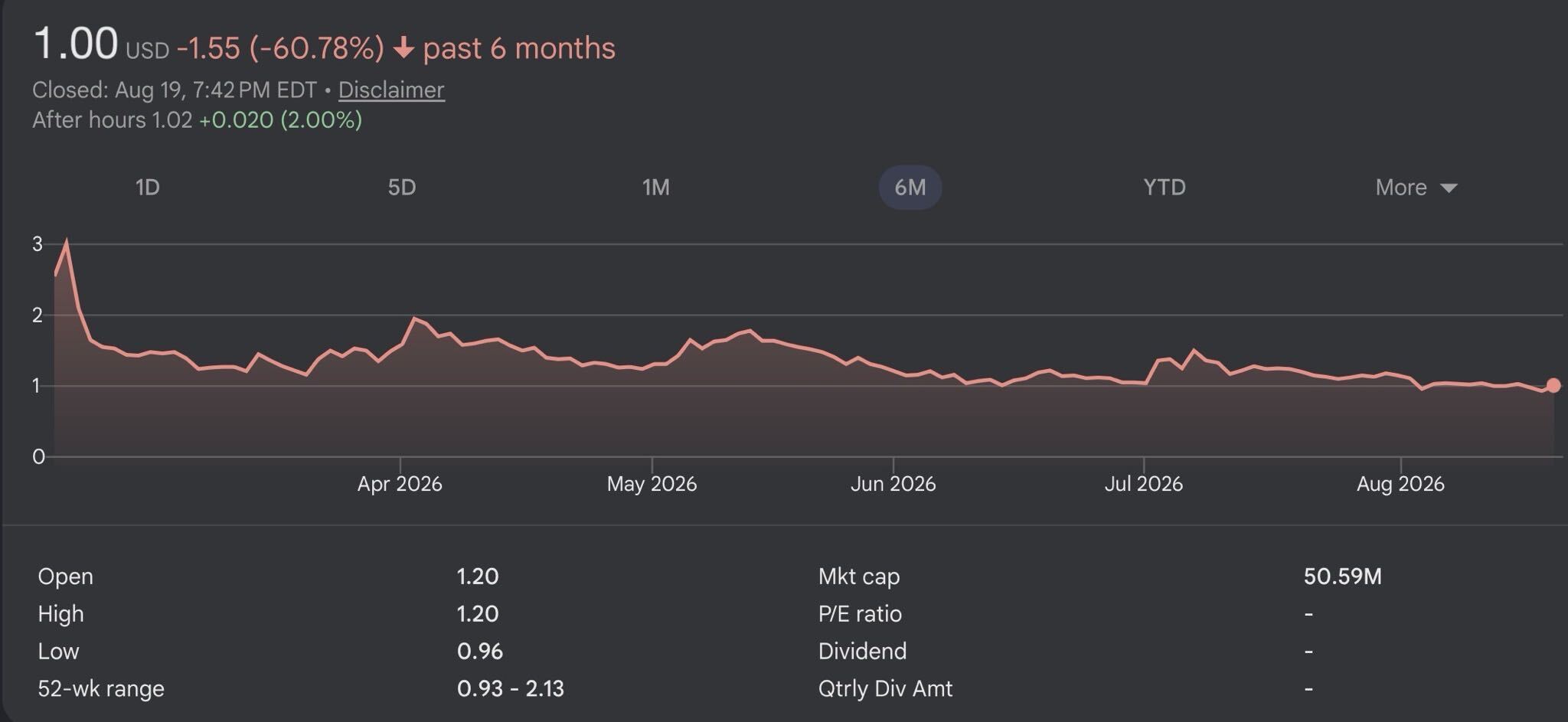
Instead, despite a brief bump in the stock price after the announcement which saw it rise from $1.30 to almost $2.00 in early April, Stablecoin Development Corporat’s share price has collapsed to $1.00 as of writing.
Read more: What the Tether audit means for the crypto industry
Interestingly, every time that the stock briefly falls below $1.00, someone or some entity purchases enough shares to push it back up.
For example, three days ago, the price of Stablecoin Development Corporat’s shares fell to $0.94. Within 24 hours the price had miraculously recovered over 6% to just over $1.00.
If any company’s share prices fall below $1.00 for a 30-day period then the company is delisted from the NYSE.
Bizarre executive leadership
Similar to how Tether and Bitfinex operated with a strange smattering of executives and equity holders in its initial years, Stablecoin Development Corporat also plays host to a curious who’s who of financiers and influencers.
To start with, at the helm of Stablecoin Development Corporat is Michael Kazley, who seems to have fallen into the CEO role by simply being one of the main investors during the reverse merger between NovaBay and Tether.
His investment fund, R01 Fund LP, placed a large wager of over $4 million on the new entity and seemingly made few, if any, other major investments.
Kazley has stated that the c-suite see USDS (and the associated SKY Protocol) as “undervalued” and that Stablecoin Development Corporat is “wildly bullish” on it, taking on a “greater than a 9% stake.”
Read more: Tether vs. Circle: The battle for stablecoin dominance
The company’s CFO is Tommy Law, who was named as interim CFO of NovaBay back in 2023.
He’s somehow retained this position despite helping to drive the medical company into the ground and holding no certifications or licenses related to his role.
Lastly, Henry Blynn, the COO, appears to be a holdover from the final days of NovaBay. The 32-year-old was brought on as a consultant in October 2025.
Board raises more questions than answers
Stablecoin Development Corporat’s board of directors is a peculiar mix of individuals completely unassociated with cryptocurrencies and stablecoins.
For instance, Yenyou Zheng, who chairs the audit committee and nominating and corporate governance committee and sits on the compensation committee for Stablecoin Development Corporat, was listed in the ICIJ’s Panama Papers for his involvement with China Vitup Healthcare Holdings.
The now defunct Dalian, China-based entity was once listed on OTCMarkets as China Vitup Hospital before changing its name to Emergency Pest Services, and most recently to Clean Vision Corporation.
Also on the board, and sitting on all three committees, is Swan Sit, a Hong Kong native who emigrated to Boston at the age of six.
She calls herself a “thought leader and business disrupter,” and has played a marketing role for numerous brands throughout her career. It’s unclear how she’s qualified to sit on the audit or compensation committees.
Finally, Paul E. Freiman, according to a personal biography from a cancer research company, has exclusively worked for pharmaceutical companies for more than four decades. Why he’s involved with a stablecoin holding company post-biopharmaceutical dismantling is unclear.
Regardless of the executive leadership, board of directors, hypothetical plans for exponential growth, and wildly bullish sentiment on the stablecoin ecosystem, Stablecoin Development Corporat has been struggling to keep it’s corporate head above the water of a depressed cryptocurrency market.
Protos will keep an eye on whether the newly minted company can meet its own expectations or soon be relegated to the Pink Sheets.
Got a tip? Send us an email securely via Protos Leaks. For more informed news and investigations, follow us on X, Bluesky, and Google News, or subscribe to our YouTube channel.