
SpaceX IPO banks yell ‘buy’ as stock craters

Wall Street analysts are trying to rescue Elon Musk’s floundering IPO, SpaceX after the stock erased $1.1 trillion of market capitalization in five weeks.
Almost every Wall Street analyst has a price target (PT) higher than the stock price, with reiterations and upgraded forecasts arriving by the day, and all 12 IPO underwriters whose analysts have published research on SPCX rated it a “buy” or equivalent.
Bullish analyst ratings have showered Musk’s company with weeks of praise as the stock price has crashed. Yesterday, Macquarie reiterated its “outperform” rating with a PT 100% higher than SPCX’s closing price.
Last week, Piper Sandler initiated coverage with a $156 PT, $32 higher than yesterday’s close. The same week, Needham maintained its buy rating and increased its PT 25% to $250, Evercore ISI Group initiated at outperform with a $230 PT, and Zephirin Group initiated coverage at buy with a $310 PT.
The tone around these ratings has been one-sided for weeks. Ratings by the investment banks that actually helped sell the stock during the IPO have sustained a sound wall shouting nothing but buy.
Raymond James initiated coverage at “strong buy” and an $800 PT. Eight hundred dollars.
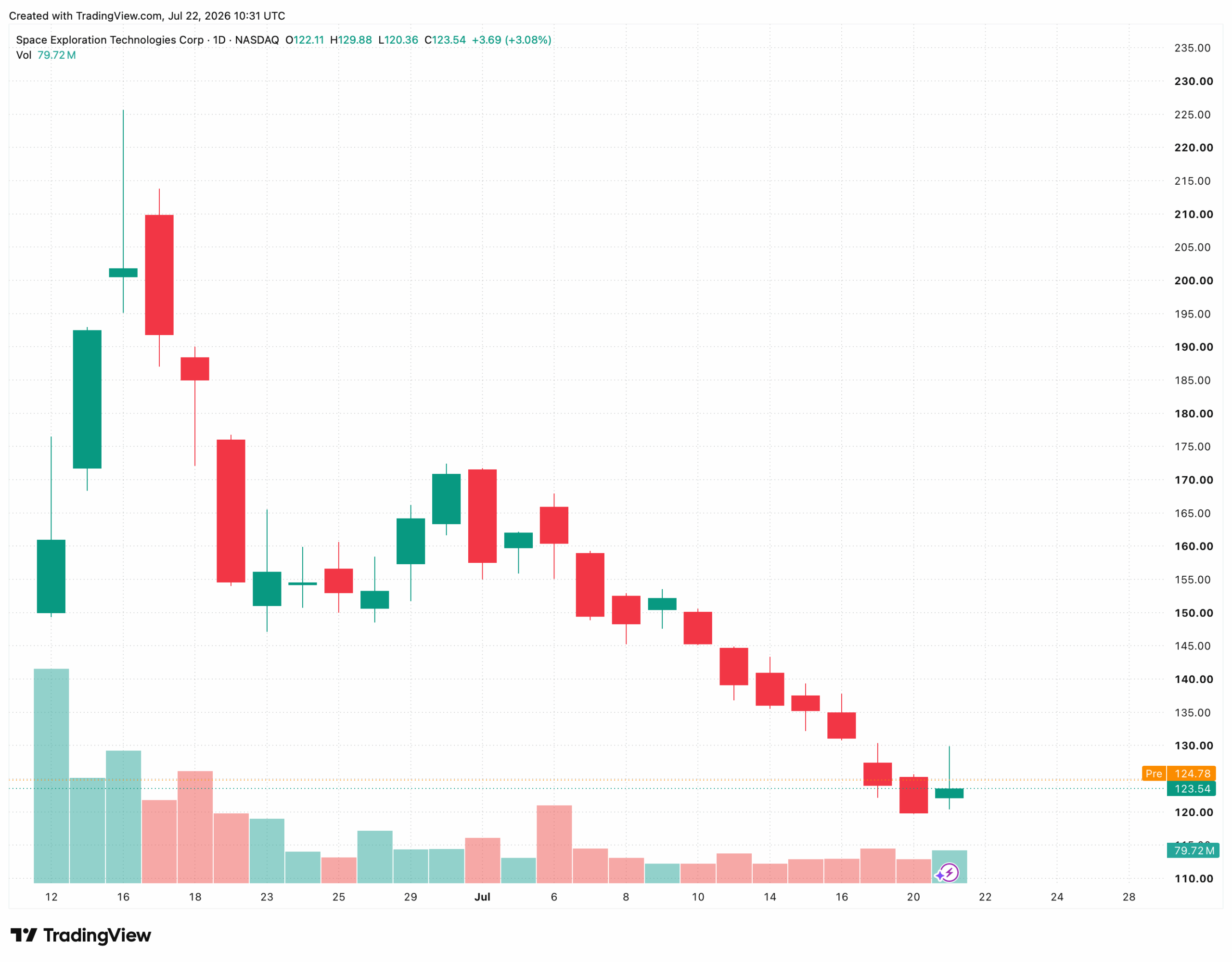
The stock closed yesterday below $125, down 45% from its June 16 high.
Hiking PTs and buys since the SpaceX IPO
Goldman Sachs led a record-shattering, 23-bank syndicate that priced SpaceX’s record $75 billion IPO at $135 a share on June 11. It would open for trading on the Nasdaq at $150.
For that one day in the sun, the banks split roughly $500 million in fees, with Goldman and fellow lead Morgan Stanley collecting about $100 million apiece.
Their gratitude showed. Bank of America crowned SpaceX the “King of the Cosmos” alongside a $235 PT. Deutsche Bank called the company the “apex of civilizational ambition” and set a $255 PT.
Citi described its $200 target as a “milestone along the path to $900.” Morgan Stanley titled its SPCX analysis “AI’s Final Frontier,” attaching a $300 PT.
Gushing affirmations reeked of conflicts of interest.
Raymond James, a co-manager on the IPO, called SpaceX “one of the defining industrial infrastructure companies of the 21st century.” Its $800 PT, Wall Street’s highest, is more than six times the current share price.
Read more: Some SpaceX bonds have already sunk to junk-like territory
Analysts without conflicts of interest have lower PTs
Firms that didn’t directly benefit from the IPO saw a different, far more accurate future.
MoffettNathanson initiated at neutral with a $131 PT and wrote, “There is simply no credible financial model that can support what is at the time of this writing a roughly $2 trillion valuation. Our own certainly does not.”
CFRA issued Wall Street’s only outright “sell” rating and a $115 PT on the stock’s first day of trading. It was the most accurate PT to date, with shares falling to within $5 of that forecast this week.
Another IPO outsider, KeyBanc, added the first “hold-equivalent” analyst rating on June 22, a session in which the shares dropped 16%.
So far, the stock price is rewarding skeptics, not the conflicted banks and Wall Street giants that SpaceX compensated to remain permabullish.
SpaceX peaked at $225.64 on June 16, when the company was briefly worth more than $2.9 trillion. The shares broke below their $135 IPO price on July 15 and closed under it a day later.
This week, they traded below $120 after SpaceX delayed its highly-anticipated Starship test flight when some of its engines failed to start.
Meanwhile, some SpaceX bonds have already declined to 90.7 cents on the dollar with junk-like, 7.5% yields. Yet 29 analyst ratings still average a $236 PT, as though the stock has a realistic chance of nearly doubling from Tuesday’s close near $124.
Whatever the stock does next, Wall Street’s IPO fees settled weeks ago.
Got a tip? Send us an email securely via Protos Leaks. For more informed news and investigations, follow us on X, Bluesky, and Google News, or subscribe to our YouTube channel.