Skyrocketing borrow rates are proving an insufficient incentive to free up liquidity in DeFi giant Sky’s stUSDS market, with founder Rune Christensen reportedly making up approximately half of the borrowed funds.
The market, on which liquidations are paused, has been at full utilisation for several days, leaving USDS depositors unable to withdraw their funds.
Consequently, the cost of borrowing USDS via stUSDS has spiked to 25% APY, up from just 5% last month, and may hit 50% within days.
Without the threat of liquidation, the borrowers needn’t fear, unless Sky’s DAO governance steps in which, given who a large portion of the loans belong to, seems unlikely.
That said, the SKY token, collateral against which stUSDS deposits are borrowed, is down over 20% in the past 24 hours, possibly anticipating sales to free up funds for repayment.
Christensen calls the worries about Sky “overblown” and stresses the protocol is strong. He does however recognize there are “questions about stUSDS” and that they will be addressed soon.
Read more: Wallet tied to Sky founder borrowed $1M days before his company collapsed
DeFi insiders aren’t worried about the health of the wider protocol, though.
Former Maker DAO delegate “PaperImperium” estimates that, even at max (50%) borrowing cost, “it would take several years to be in danger” and that only stUSDS holders would suffer a loss.
Similarly, former Aave delegate Marc Zeller says there’s “nothing wrong” and that the stUSDS product is Christensen’s “private credit line to fund his pet projects segregated from the main saving yield.”
While there may be limited contagion risk, with little incentive to repay, it doesn’t look like significant repayments are imminent.
Even when a small amount is repaid, the slack is picked up by MEV bots, maxing utilization once more.
Read more: Aave snubs Sky’s USDS as collateral and 3 ‘underperforming’ chains
Exit strategy
The stUSDS/USDS pool on decentralized exchange Curve Finance, which was set up a year ago to provide “supporting liquidity” to stUSDS holders, has shown volatility in the stUSDS/USDS exchange rate over the past week.
The pool’s $2 million of liquidity is currently made up of over 90% stUSDS, leading to the price divergence.
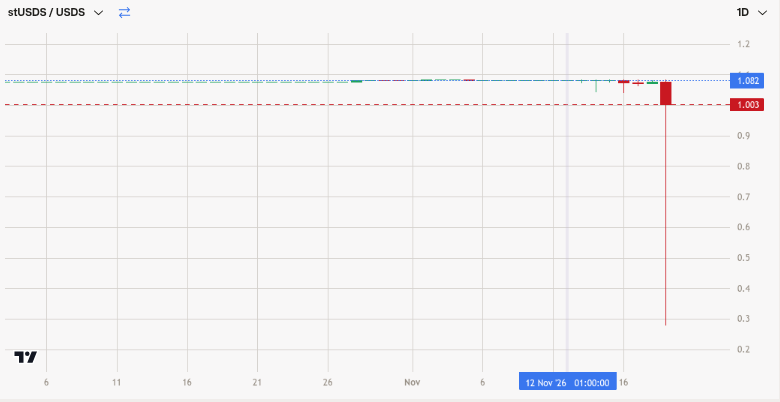
Prior to current developments, the stUSDS/USDS exchange rate was around 1.08, but the chart currently shows trading around par, with one particularly painful wick down to around 0.3.
Coincidentally, Curve Finance founder Michael Egorov previously pulled a similar strategy, borrowing multimillion sums of various stablecoins against his governance tokens, resulting in a liquidation cascade and plummeting CRV price in 2023.
Read more: Curve Finance founder Michael Egorov hit amid $22M CRV liquidation cascade
North Korean hackers also using Sky
While the stUSDS supply of $160 million is not to be sniffed at, it’s dwarfed by Sky’s overall stablecoin supply of $6.5 billion between USDS and legacy DAI.
These tokens maintain their dollar value via the protocol’s peg stability module (PSM), a 1:1 stablecoin exchange which has caught presumably unwanted attention.
CoinDesk reports that over half a billion dollars of illicit transactions have flown through the PSM over the years, including over $100 million tied to North Korean hackers.
With US authorities enthusiastically taking to freezing stablecoins in response to October’s Binance hack, some began to worry about the risk to pooled DeFi assets should the contracts holding commingled illicit funds be frozen.
Read more: LIVE: Binance says it’s yet to open up more token withdrawals
Possibly out of an abundance of caution, a Poloniex-labelled wallet reportedly converted $1.5 billion of USDS and sUSDS via Sky’s PSM, depositing the USDC into Aave.
Sky has played down the threat, noting that front ends block sanctioned entities and stressing that the funds flagged by CoinDesk “represent roughly 0.03%” of the almost $1 trillion of volume the PSM has processed to date.
Got a tip? Send us an email securely via Protos Leaks. For more informed news and investigations, follow us on X, Bluesky, and Google News, or subscribe to our YouTube channel.