
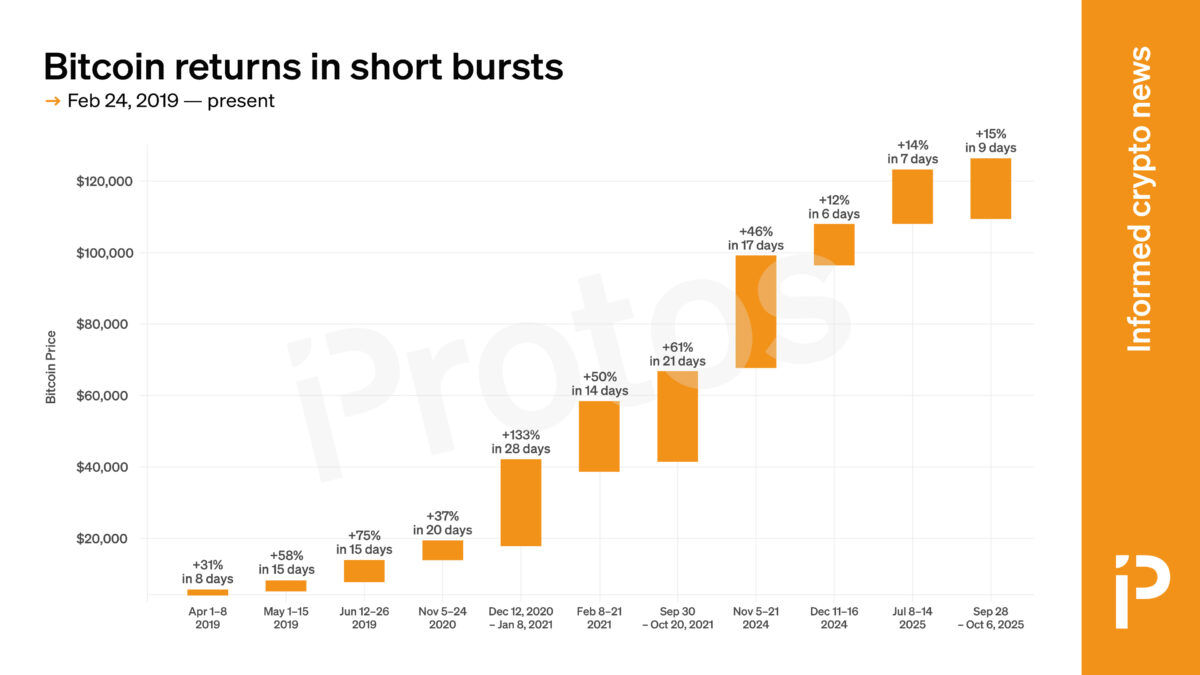
CHART: Bitcoin returns in short bursts
Even though bitcoin (BTC) is, historically speaking, one of the best performing assets of all time, on most days its performance isn’t actually all that impressive. In fact, almost all of its long term returns are crammed into a small number of trading sessions.
The rest of the time, it chops around.
For example, on November 17-18, 2013, BTC rallied 50%. Take these two days out of the equation and every early Bitcoiner’s return would be halved.
Elsewhere, on July 20, 2017, BTC rallied 27% and in December of that same year, it surged 40%.
To have made the most of the rally that’s exceeded one million percent between 2009 and July 2012, investors needed to be holding during rare bull runs.
Read more: Bitcoin Core promotes first Trusted Keys maintainer in three years
Visualizing the uneven returns of bitcoin
There are various ways to visualize the irregular days that generate the vast majority of BTC investment returns.
The most appropriate method might be a giant calendar highlighting the tiny number of days responsible for the majority of BTC returns.
Similarly, the same calendar could highlight the fewest days that would have zeroed out the lifetime return of BTC if an investor hadn’t held on during those days.
That number is shockingly small: less than 100 of the 5,000 days since July 2012.
Whereas a vast and mostly blank calendar certainly conveys the message about clustered outperformance amid normally unremarkable behavior, perhaps the most visually compelling way to track this data is to show the price change by periods of significant rallies.
From a starting point exactly seven years ago, there have been 11 significant BTC rallies that achieved new highs. The above chart illustrates these periods.
- April 1-8, 2019: $4,095 to $5,347, a 31% gain in eight days
- May 1-15, 2019: $5,268 to $8,300, a 58% gain in 15 days
- June 12-26, 2019: $7,916 to $13,880, a 75% gain in 15 days
- November 5-24, 2020: $14,168 to $19,442, a 37% gain in 20 days
- December 12, 2020-January 8, 2021: $18,031 to $42,000, a 133% gain in 28 days
- February 8-21, 2021: $38,870 to $58,354, a 50% gain in 14 days
- September 30-October 20, 2021: $41,538 to $67,017, a 61% gain in 21 days
- November 5-21, 2024: $67,817 to $99,121, a 46% gain in 17 days
- December 11-16, 2024: $96,658 to $107,821, a 12% gain in six days
- July 8-14, 2025: $108,286 to $123,236, a 14% gain in seven days
- September 28-October 6, 2025: $109,679 to $126,272, a 15% gain in nine days
Eleven periods outperformed BTC
As a simple, non-cumulative sum, these rallies are worth 532% or one-third of the 1,540% BTC rally from $4,100 seven years ago to its $67,200 price as of writing.
On a compounded basis, those 11 trading periods are worth 5,800% or nearly quadruple the actual seven-year gain in BTC.
Yes, had an investor only held during those periods and reinvested fully each time, they’d have substantially outperformed BTC.
Of course, no investor can magically time the market perfectly. Nonetheless, this exercise shows how important the returns of a very short number of days are to the overall returns of one of the world’s all-time best-performing assets.
Got a tip? Send us an email securely via Protos Leaks. For more informed news, follow us on X, Bluesky, and Google News, or subscribe to our YouTube channel.