Following Michael Saylor’s advertisements likening STRC to a high-yield bank account or money market, Strive swapped $50 million of the cash it had in March for STRC, and soon added another $500,000.
As of a new filing, the asset manager quietly disclosed that its shares were worth just $44.18 million as of July 10, a paper loss of roughly $6.3 million excluding dividends.
Although it published a glowing press release about its purchase, the admission of loss sat otherwise unannounced in an SEC filing, tucked between cash and BTC balances.
Unlike the purchase, no press campaign trumpeted the loss.
The instrument that Strive pitched as a cash-like hold has lost about 12% of its value relative to cash, and the dividends it received from holding STRC came nowhere close to closing that gap.
Strive used over a third of its cash holdings at the time for its STRC purchase.
What Strive said it was buying
CEO Matt Cole, who serves at Strive after years managing money at the California pension giant CalPERS, initially sold the trade as prudent treasury management.
Incredibly, he claimed at the time that Strive opted for STRC “instead of holding idle cash earning low yields in money market funds.”
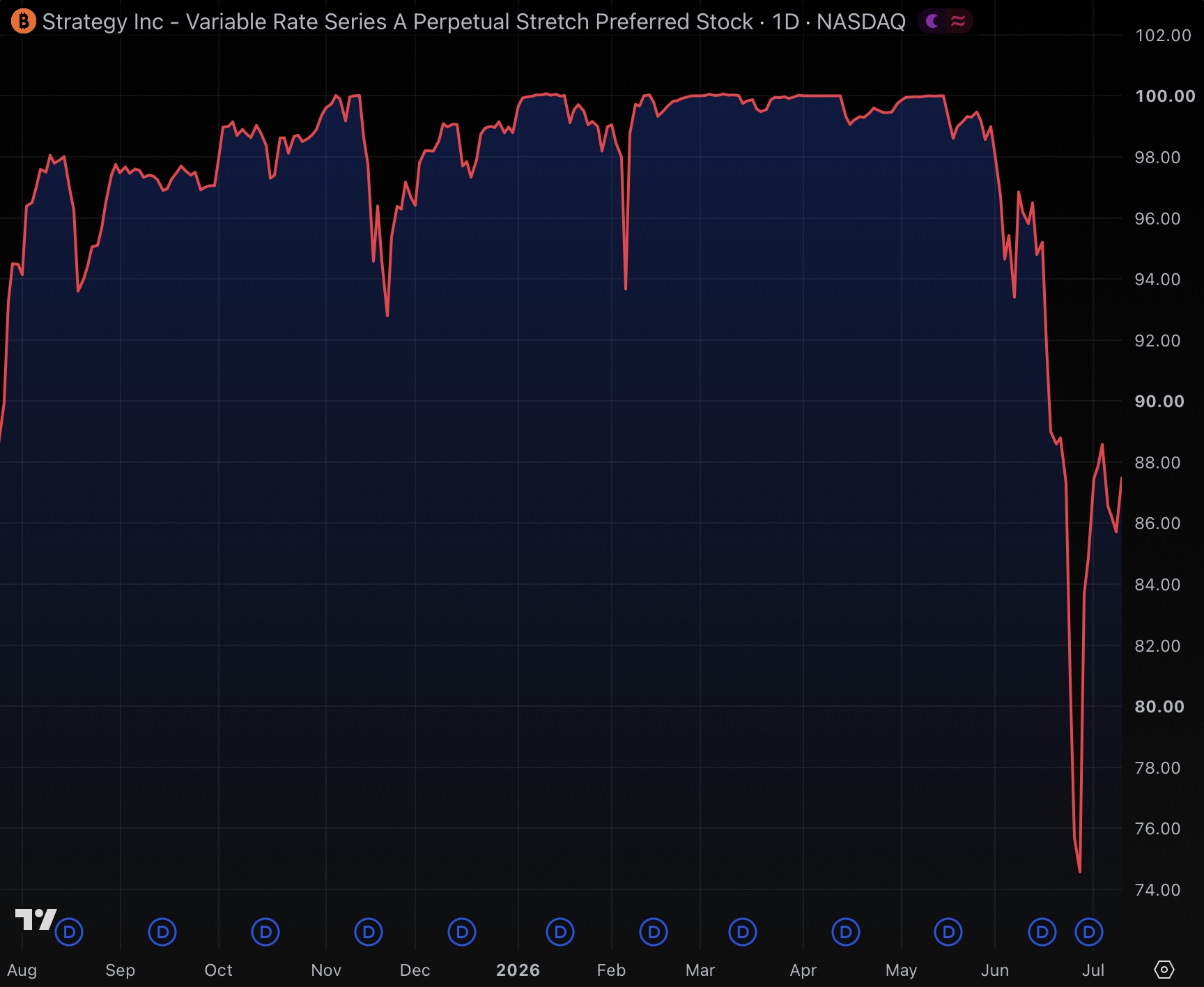
Although STRC is nothing like a money market and has, in fact, lost 28% of its value at its June 26 low, Strive initially claimed that STRC would “provide strong yield dynamics while maintaining stable price behavior.”
Obviously, it hasn’t.
Unlike a bank account or money market, STRC fluctuates in price daily on the Nasdaq stock exchange. Strategy says it should trade close to its $100 par value due to its fine-tuning of dividend rates, a dubious mechanism Protos has documented at length.
Strive even counted its STRC shares toward its own so-called “reserve” backing dividends on its competing product, SATA, another quasi-stable, dividend-paying stock.
Unlike an insured savings product, neither STRC nor SATA offer guarantees to preserve principal, offer deposit insurance, nor provide rights to redeem at par from the company.
Whatever a Nasdaq trader will pay is what the shares are actually worth.
Read more: No amount of cash can fix STRC’s trust problem
Strive starts wishing it had just held cash
Strive’s $5.8 million unrealized loss on its $50 million purchase actually understates the extent to which it bet went poorly.
To be precise, the company bought 500,000 shares at STRC’s full $100 par in March. It never bothered to bid for a discount — a mistake that cost it dearly.
Sometime before April 2, Strive quietly added about 5,000 more shares. The extra stake was worth roughly $500,000, lifting the true outlay to about $50.5 million. Indeed, its April 6 filing pegged its holdings at $50.5 million.
From there, STRC began to drift lower, soon collapsing into free fall and shedding roughly a quarter of its value within two weeks.
As leverage unwound and prices of every BTC treasury company collapsed alongside the asset itself, STRC bottomed at an all-time low of $71.25 on June 26.
At that price, Strive’s 505,000 shares were worth $36 million. That is, in other words, a hole of more than $14 million against the $50.5 million it once held.
After negative $14 million, negative $6 million is less worse
As of July 10, the price of STRC had “recovered” to make Strive’s $14 million unrealized loss “only” roughly negative $6 million.
That volatility and commensurate risk is sadly comparable to the cost of doing nothing with all of its $50.5 million initial cash position.
Measured against Strive’s $50.5 million cost basis, the company’s unrealized loss excluding dividends is roughly $6.3 million, or 12.5%.
Strive’s loss stood at about $1.8 million, or 3.7%, when Protos checked in early June.
The numbers are now more than three times as bad.
Dividends haven’t made up for STRC’s crash
To be fair, STRC has paid dividends along the way, so those payments have softened the blow ever so slightly.
Over Strive’s holding period since March, STRC’s annualized dividend rate has been close to 11.5%, and Strive has been holding long enough to collect 4.5 months worth of dividends.
In other words, it’s received roughly 4.4% on its principal — still far from enough to recover from its 12.5% unrealized loss on the lower value of its shares.
Even after adjusting for dividends received, Strive had still lost over $4 million holding STRC versus simply holding cash as of July 10. STRC closed yesterday a mere 1% higher than July 10, so updating the math to current prices would barely budge.
In summary, Strive’s failed swap of cash for STRC is simply a consequence of believing advertisements from Strategy and its founder. Strategy’s own BTC treasury is deeply underwater to the tune of billions of dollars, and STRC’s slide reflects doubt that Strategy can sustain the stock anywhere close to $100 per share
Companies holding STRC and Strategy’s other securities have paid the price.
Strive told shareholders STRC would be better to hold than idle cash. Idle cash, it turns out, would have at least maintained its dollar value.
Got a tip? Send us an email securely via Protos Leaks. For more informed news and investigations, follow us on X, Bluesky, and Google News, or subscribe to our YouTube channel.