
Nakamoto lost $238M in Q1 while exec compensation soared 7x
It pays to be an executive at a bitcoin (BTC) treasury company, and in David Bailey’s case, those payments come from his shareholders.
Nakamoto CEO Bailey boasted on X that his Nasdaq-listed firm closed the first quarter of 2026 holding more than 5,000 BTC worth roughly $345 million.
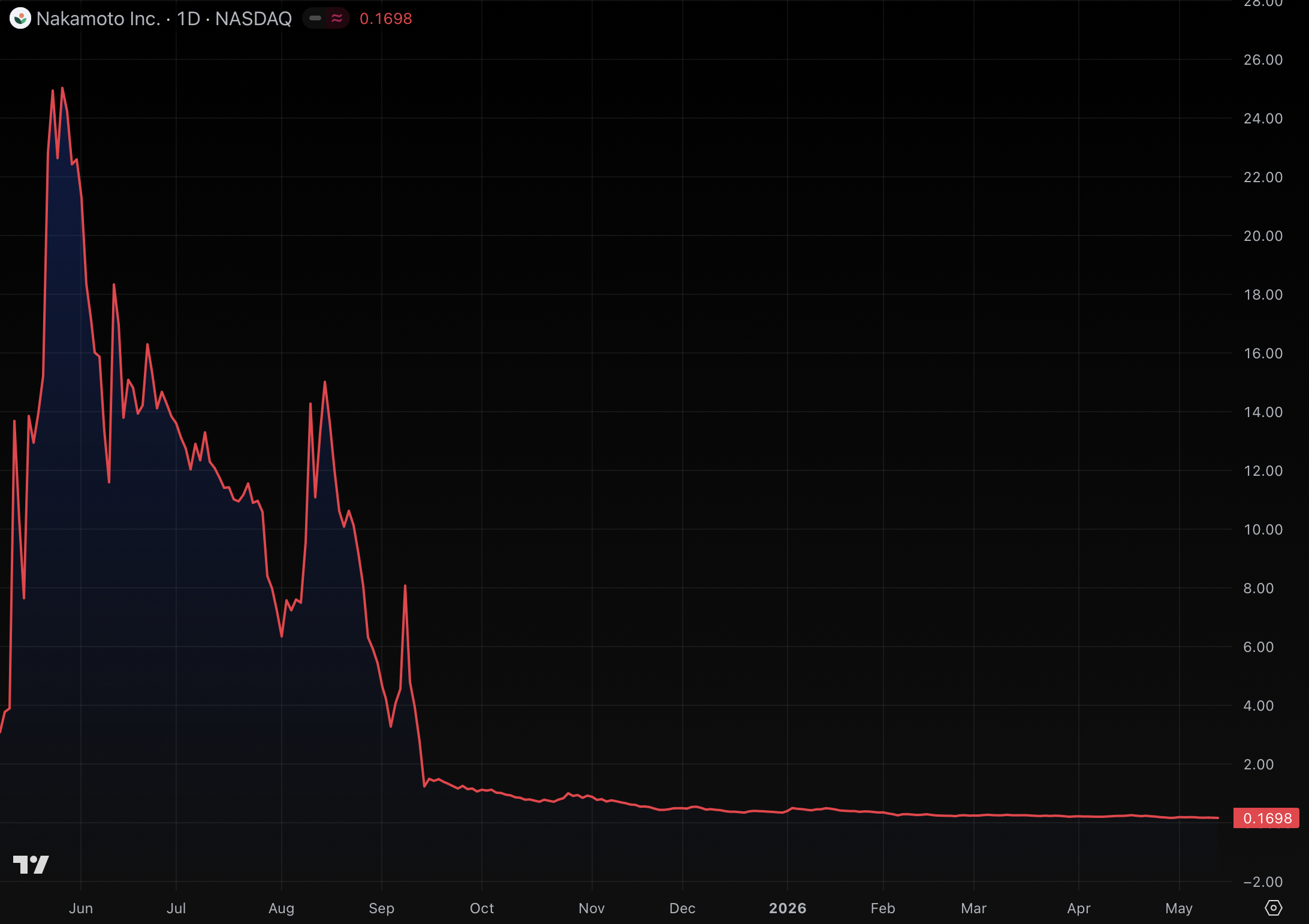
Yet during Q1, shareholders lost 39% of their investment, from $0.36 to $0.22 per share.
Despite Nakamoto’s $238 million net loss in Q1, compensation expenses jumped 7x. For example, a February related-party deal handed roughly 286 million newly issued shares to former owners of two private companies that CEO Bailey and Chief Investment Officer Tyler Evans controlled.
NAKA stockholders celebrated that day with a bid for shares 99% lower than their 52-week high.
Nakamoto’s executive compensation packages are staggering in light of its abysmal stock performance. One critic asked, “What about spending $23 million on salaries and compensation when $NAKA is down 98% from its high.”
Another shareholder publicly demanded that Bailey’s investor dashboard disclose “total executive compensation.”
David Bailey got rich while his shareholders got poor
Since joining the company, Bailey and his wholly-controlled consultancies have received tens of thousands of dollars per month in cash compensation in addition to massive equity awards.
Under his leadership, Nakamoto recorded a $102.5 million loss on the fair value of its BTC during Q1. The company’s 5,064 coins carry an astonishingly high cost basis of $118,273 apiece.
Within just the first three months of 2026, its $599 million investment had declined 42% to under $346 million.
Worse, the company’s coins aren’t even unencumbered assets. Instead, Bailey has allowed the firm to become heavily indebted.
Of its 5,064 coins, Nakamoto had pledged 4,405 as collateral against a $210 million USDT loan from Kraken as of March 31. The loan matures in December and requires 8% interest payments plus full principal repayment.
On social media, Bailey boasted about his company’s 5,000 BTC. Conveniently, he omitted that 87% of those coins were on loan.
Bailey also approved the company’s decision to invest in Metaplanet. That decision had lost the company at least $3.9 million by the end of Q1.
As revenue to offset these losses, all four of the company’s business divisions — media, advisory, healthcare, and asset management — generated a combined $2.7 million of total operating revenue.
Read more: Bitcoin treasury Nakamoto down 98% — still pays David Bailey lavishly
Despite shareholder losses, a windfall for management
In February, Nakamoto closed all-stock acquisitions of Bailey’s companies BTC Inc. (parent of Bitcoin Magazine and The Bitcoin Conference) and UTXO Management.
The 10-Q acknowledges that conflict in Note 11, stating that both companies “were considered related parties of Nakamoto as David Bailey, our chief executive officer and chairman of the board of directors and Tyler Evans, our chief investment officer, each had significant influence over BTC Inc and UTXO through their prior ownership of and leadership positions within BTC Inc and UTXO.”
BTC Inc equity owners received hundreds of millions of NAKA shares plus tens of millions for UTXO. Nakamoto priced the deal off the February 19 closing price of $0.2482 per share, after the stock had already collapsed roughly 99% from its 2025 high.
It then proceeded to trade even lower.
The combined consideration Nakamoto recorded was $181 million: $128.6 million of “fair value” for BTC Inc’s equity interests plus $52.8 million for “fair value” of UTXO.
After all that fair value accrued to NAKA, the stock closed yesterday within a penny of its literal 52-week low.
Shareholders left holding Bailey’s bag
Compensation expenses for labor at Nakamoto jumped 7x to $7.3 million in Q1 2026 from $1.0 million the prior year.
Stock-based compensation alone was $1.6 million. General and administrative expense rose to $9.8 million, up from just $0.6 million in Q1 2025.
Still, Bailey personally owns millions of dollars worth of Nakamoto equity. He also sat on both sides of the related-party transactions that just added hundreds of millions of new shares into the supply.
He has made millions personally as total compensation for presiding over Nakamoto’s share price decline of 99%.
Shares outstanding rose from 437.9 million on December 31 to 690 million by March 31, diluting shareholders by 58% within three months.
Stockholders also approved a reverse stock split of one-for-20 to one-for-50 on May 8, with the board to pick the exact ratio. Companies trying to dodge Nasdaq delistings typically reach for that reverse split lever.
Protos has previously documented Nakamoto’s 98% peak-to-trough collapse and its momentary, 23x valuation multiple atop its BTC holdings.
Today, the company is worth less than the BTC it holds.
Got a tip? Send us an email securely via Protos Leaks. For more informed news and investigations, follow us on X, Bluesky, and Google News, or subscribe to our YouTubechannel.