
The number of BTC wallets holding more than 0.1 BTC hasn’t grown in two years
Since the Bitcoin network’s launch in 2009, the number of unique bitcoin (BTC) addresses holding a balance greater than 0.1 BTC increased every year through 2023.
However, over the past 24 months, that cohort has been shrinking.
Indeed, since December 8, 2023, the number has declined from 4,548,107 to 4,443,541.
When we chart this metric, we see that the number of unique addresses has risen steadily (despite some brief blips lasting a few months), peaking in December 2023.
It plateaued through most of 2024, and then began to slide into today’s somewhat historic, two-year low.
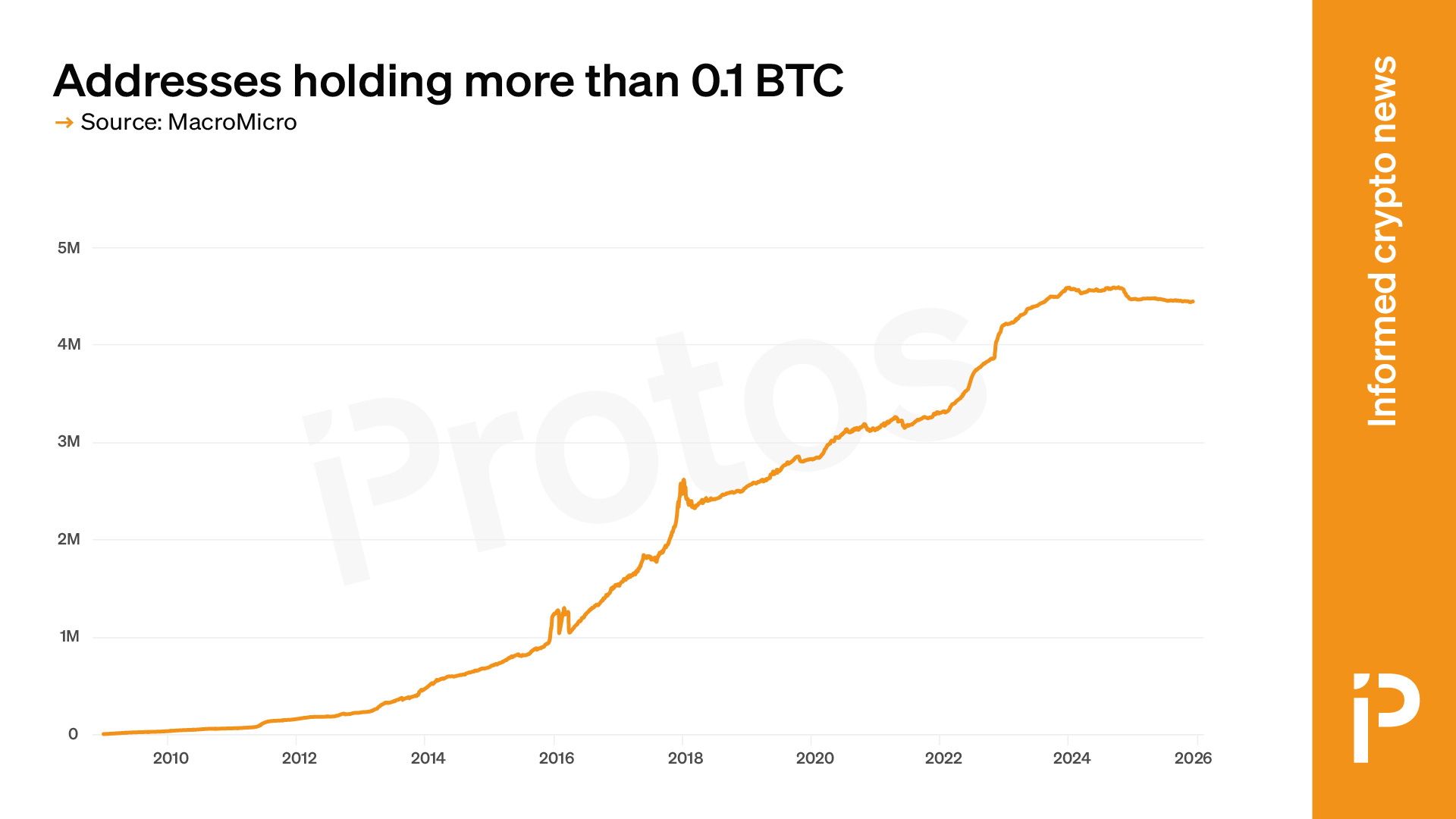
That 2.3% decline is substantially worse than the 0.7% decline in addresses holding one-tenth less (0.01 BTC), indicating less willingness by investors to hold larger balances within single wallets over the past two years.
There has never been a two-year period during which this metric declined prior to this month.
Are there fewer investors with more than 0.1 BTC?
On its face, the metric seems to indicate a dwindling number of BTC investors holding a few thousand dollars worth of BTC in a Ledger, Trezor, Coldcard, or similar wallet.
Of course, it’s impossible to determine whether the actual number of people holding less than 0.1 BTC has declined or not.
Nowadays, in stark contrast with the early days of the Bitcoin network, there are thousands of centralized exchanges, ETFs, derivatives, treasury companies, and other financial proxies that grant exposure to the price of BTC.
It’s impossible to disaggregate this commingled BTC on-chain to determine the quantity of holdings per person.
Read more: 95% of all bitcoin is now mined and circulating
New technologies to distribute BTC across addresses
A hardware wallet is the oldest and most secure way to hold BTC, but alternatives are widely available. Many investors, for example, use ETFs and other exchange-traded products that satisfy retirement account requirements, unlike spot BTC.
In addition to the proliferation of BTC proxies, investors have also got wise to the security practices of unspent transaction output consolidation. They’re using extended public key to distribute holdings into multiple wallets controlled by one private key, Matryoshka doll-like embedded wallets with decoys for safekeeping, or cryptography like XOR to combine seed phrases from numerous wallets.
All of these security practices are becoming increasingly commonplace, meaning that holding a single address with more than 0.1 BTC is becoming increasingly unnecessary, regardless of the size of one’s investment.
Still, tracking this popular norm over time provides a unique insight into the behavior of Bitcoin network users.
While investors wanted to continue to accumulate large balances in single addresses worth thousands of dollars through 2023, that trend has reversed over the past two years.
Got a tip? Send us an email securely via Protos Leaks. For more informed news, follow us on X, Bluesky, and Google News, or subscribe to our YouTube channel.