
The more Jack Mallers says Twenty One is ‘different,’ the more its stock falls

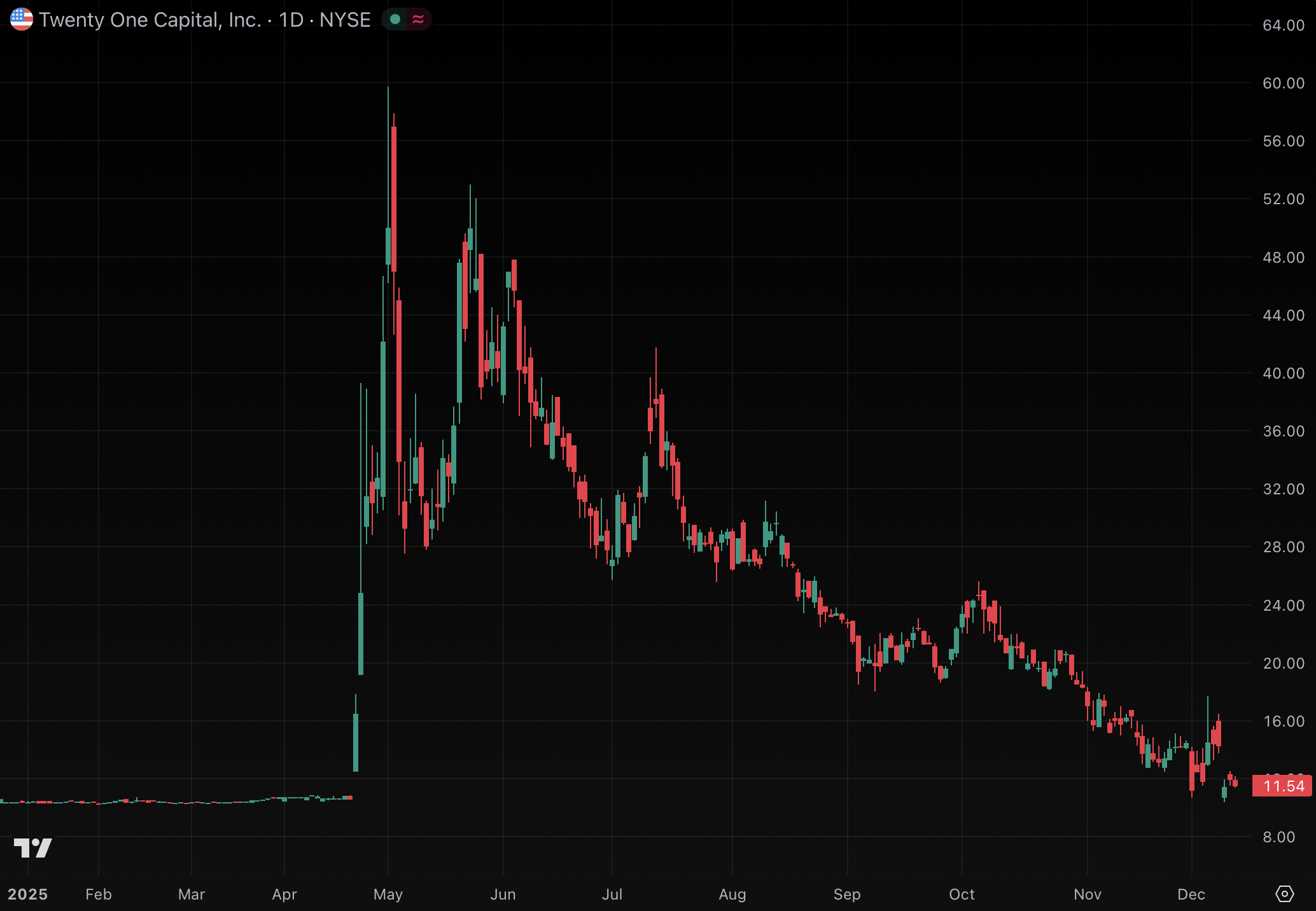
Over the last month, shares of Jack Mallers’ Tether-supported public company Twenty One have lost a quarter of their value.
Despite Mallers’ insistence that he’s different from all the other bitcoin (BTC) industry executives, his stock price has the same story as everyone else.
Over the same time period, Michael Saylor’s Strategy, the world’s largest BTC treasury company, has declined by an identical 25%. Peers in the BTC treasury sector are essentially in line with Saylor.
Vivek Ramaswamy’s Strive Asset Management is down 31%, David Bailey’s Nakamoto is down 36%, Adam Back’s H100 Group is down 31%, Xin Jin’s Cango is down 31%, and Eric Semler and Natalie Brunell’s Semler is down 30%.
Mallers’ supposed differentiation of Twenty One doesn’t seem to be convincing investors. Their sales of his stock are indiscriminate.
Twenty One holds 43,514 BTC worth $3.92 billion. Those holdings exactly match its current market capitalization, meaning that investors currently place $0 premium on all of Mallers’ supposed differentiated value propositions.
These include cash flow, strategic alliances, his business acumen, and that of Twenty One shareholders Tether, Cantor Fitzgerald, and Softbank.
That Mallers has been unable to convince investors to pay anything beyond the liquidation value of the company’s BTC is incredible given his who’s who of billionaire backers.
The list features such names as Softbank’s Masayoshi Son with an estimated $38 billion personal net worth, Tether’s Giancarlo Devasini with $13 billion, Tether billionaires Jean-Louis van der Velde and Paolo Ardoino, and the son of billionaire US Commerce Secretary Howard Lutnick.
The intent to have cash flow
Mallers has nebulously claimed that Twenty One isn’t just a passive balance‑sheet trade like the dozens of other digital asset treasury stocks, despite its market cap exactly equaling its treasury value.
In Mallers’ mind, Twenty One is a “Bitcoin‑native” operating business explicitly focused on growing “BTC per share” through multiple business lines.
“We’re bringing a lot of BTC products to market with the intent to have cash flow,” Mallers told a CNBC television audience yesterday.
So far, however, the company hasn’t reported any cash flow in quarterly earnings.
Worse, its stock price has underperformed the S&P 500 by about 500 basis points year to date — a time period that spans to before the Cantor SPAC even merged with Twenty One.
Read more: Mallers says no bitcoin rehypothecation at Strike — but what about re-pledging?
In other words, even if someone had pre-purchased shares in the public company that took Twenty One public using insider knowledge about Tether’s deal, its half dozen billionaire backers, the support of Softbank, and the company’s countless media appearances, they still would have made more money just buying a stock market index.
Even slightly underperforming the S&P 500 by insider trading would have been the best case scenario.
In fact, almost every retail investor in Twenty One has lost money. Since the deal was announced on April 23, its stock price has only spent a single trading day at prices lower than today’s price.
Every other investor, for 157 trading days, has lost money. From its peak in May, the stock has declined 80%.
Got a tip? Send us an email securely via Protos Leaks. For more informed news, follow us on X, Bluesky, and Google News, or subscribe to our YouTube channel.